If you are budgeting for a home in Corona de Tucson, the mortgage is only part of the story. Monthly ownership costs here can shift based on water use, summer electric demand, septic versus sewer service, and the upkeep that comes with desert landscaping and exterior materials. If you want a clearer picture of what homeownership may really cost, this guide will help you plan for the line items that matter most. Let’s dive in.
Why monthly costs vary in Corona de Tucson
In Corona de Tucson, ongoing ownership costs are often more parcel-specific than buyers expect. Two homes with similar sale prices can carry very different monthly and long-term expenses depending on utility setup, lot features, and maintenance needs.
That is especially true in an area where Tucson Water serves the community through a separate Corona de Tucson water system, some properties rely on septic systems, and summer cooling demand can push utility bills much higher. The practical question is not just what the payment will be, but what this specific home will require month after month.
Start with utilities
Utilities are usually the most important variable costs to review before you buy. In Corona de Tucson, water, electric use, and wastewater setup can all affect your budget in a meaningful way.
Water costs can rise quickly
Tucson Water’s 2024 Corona de Tucson report says the system serves more than 4,100 households and businesses and uses four active wells. For homeowners, another important detail is responsibility: Tucson Water maintains water mains and service lines up to the meter, but the line from the meter to the home is the homeowner’s responsibility.
Current Tucson Water residential billing for unincorporated customers lists a monthly service charge of $22.87 for a 5/8-inch meter. Its example bill table shows how usage changes the total quickly, with average monthly bills of $68.79 at 10 CCF, $100.07 at 15 CCF, $264.62 at 30 CCF, and $735.32 at 60 CCF.
That means irrigation, a hidden leak, or filling a pool can push a water bill into a much higher tier faster than many buyers expect. When you are evaluating a home, it helps to look beyond the base charge and think about the lot, landscaping, and water-using features.
Summer electric bills need extra attention
Tucson Electric Power says summer rates run from May through September and are higher than winter rates because peak-period service costs more. TEP also notes that air conditioning is usually the largest energy user in a home.
In practical terms, summer is often when the budget gets tested. If a property has a pool pump, electric vehicle charging, or older cooling equipment, monthly costs can rise further.
TEP does offer Budget Billing for households that want more predictable monthly payments. That option does not reduce total usage, but it can make planning easier if you want to smooth out the seasonal spikes.
Sewer or septic changes the ownership picture
In Corona de Tucson, not every home is connected to municipal sewer. Pima County says homes that are not connected use onsite wastewater treatment facilities, commonly called septic systems.
That matters both before and after closing. Pima County requires a septic inspection within six months before a property transfer when a home is served by a septic system, and buyers should confirm that status early in the process.
A septic property does not automatically mean higher monthly bills, but it does mean you need to plan for maintenance and future service needs differently than you would on a sewer-connected parcel. It is one of the most important ownership-cost details to verify upfront.
Ask about local fire district fees
One local cost buyers may not expect is the Corona De Tucson Fire District subscription. The district’s July 2024 fee schedule lists annual residential subscription rates ranging from $236.73 to $630.83 depending on square footage, and the district says rates are set annually and prorated.
Not every budgeting worksheet includes this right away, so it is worth asking whether the property is covered and how the fee applies. Even modest annual charges should be part of your true ownership estimate.
HOA dues are not one-size-fits-all
There is no single HOA pattern across Corona de Tucson. Public listings show everything from no HOA to low monthly or annual dues, which suggests association costs vary widely by subdivision and parcel.
That is why broad assumptions can be misleading. One home may have no regular dues at all, while another may include monthly or annual costs tied to common areas, roads, gates, amenities, or reserves.
Before you buy, ask these questions:
- What are the current dues?
- How often are they paid?
- What do they cover?
- Are there any special assessments pending?
- Are there separate community or neighborhood membership costs?
A local example is the Corona de Tucson Community Alliance, which describes itself as a community-focused membership organization. A 2024 membership application published in the Vail Voice listed dues of $25 per household and $30 per business member. That is not the same as a deed-restricted HOA, but it shows how neighborhood-level costs can be modest in one setting and very different in another.
Desert landscaping still has a budget
Low-water landscaping can reduce maintenance, but it does not eliminate it. In Corona de Tucson, the desert climate affects how you should think about both routine upkeep and water use.
The University of Arizona Cooperative Extension says only native and some desert-adapted plants can live on roughly 10 to 11 inches of annual rainfall. Many other plants need supplemental irrigation, which means your landscaping choices can directly affect your monthly water bill.
Pima County also points homeowners to Smartscape classes for practical landscape water conservation. That is a useful reminder that even a simple desert yard still needs a plan.
Common yard costs to plan for
A gravel-and-native landscape may cut back on mowing, but you may still need:
- Drip irrigation checks
- Irrigation line repairs
- Weed control
- Occasional pruning
- Seasonal plant replacement
HomeGuide’s 2026 landscape maintenance estimate puts general upkeep at about $100 to $200 per month on average. Actual costs can vary by lot size, plant palette, and how much of the work you handle yourself.
For properties with mature trees, trimming can also become a larger periodic expense. HomeGuide estimates tree trimming at roughly $400 to $900 per tree.
Pools can add a separate monthly cost
A pool can be a major lifestyle feature in southern Arizona, but it comes with its own ownership budget. Beyond water use, buyers should think about cleaning, chemicals, minor repairs, and the electricity needed to run pool equipment.
HomeGuide’s 2026 pool maintenance estimate puts routine service around $80 to $150 per month. It also notes that annual pool ownership often falls in the range of $3,000 to $6,000 when you combine maintenance, minor repairs, electricity, and water.
That does not mean a pool is a bad value. It simply means that if a home has one, your monthly and annual ownership costs should reflect it from the start.
Long-term maintenance matters more than buyers think
Some of the biggest homeownership costs in Corona de Tucson are not monthly bills at all. They are the repair items that show up less often but can be expensive when they do.
Stucco needs regular attention
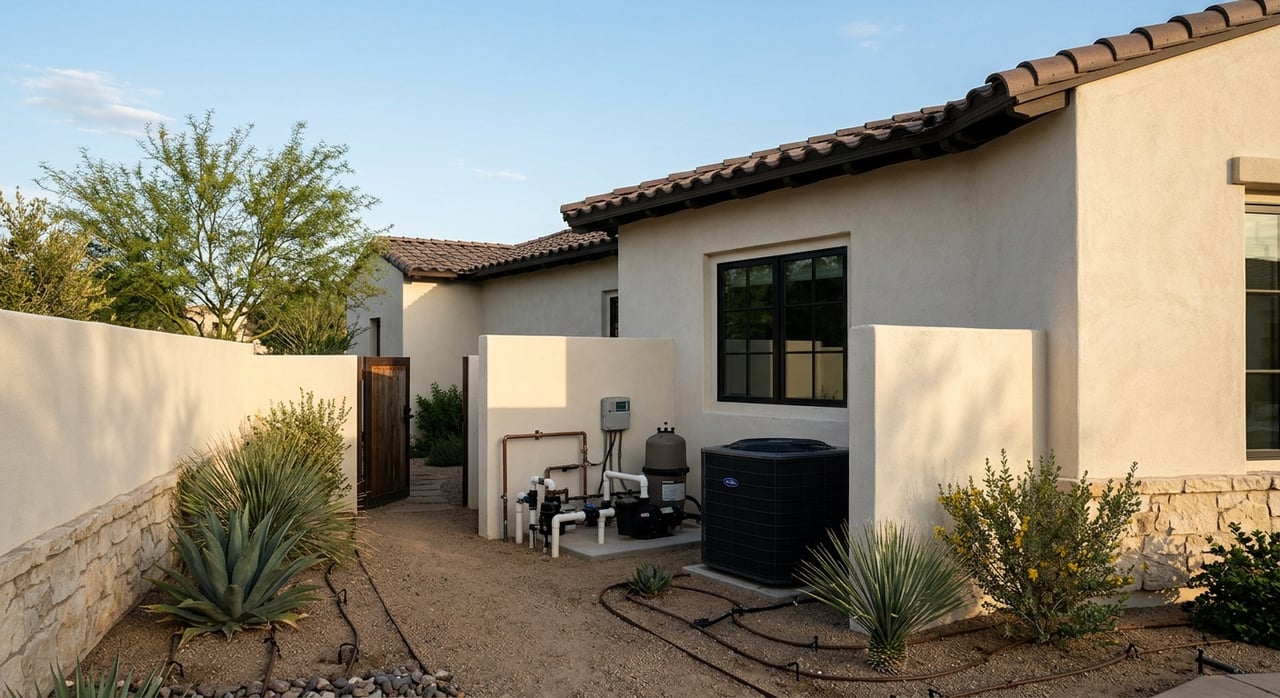
Desert exteriors are built for sun and heat, but moisture management still matters. The U.S. Department of Energy notes that exterior cladding systems can leak through small cracks, joints, and penetrations, and it recommends proper flashing and drainage details around openings.
For homeowners, the takeaway is simple: small cracks and failed sealant are not just cosmetic. Catching those issues early can help prevent larger moisture problems.
HomeGuide’s 2026 stucco cost guide estimates minor repairs at about $200 to $800, while larger or water-damage-related work can run $1,000 to $4,000 or more depending on scope. That makes regular visual checks and timely repairs part of smart long-term budgeting.
Tile roofs are durable, not maintenance-free
Tile roofs are common in this part of Arizona and can last a long time, but they still require care. The Insurance Institute for Business & Home Safety notes that tile roofs can be damaged by foot traffic and that wind-driven water intrusion can occur, which is why repairs should be handled by contractors with tile-roof experience.
HomeGuide’s current tile roof guide puts typical repair costs around $500 to $2,500. If underlayment or larger roof sections need work, costs can climb much higher.
For buyers, this is a good reminder to look beyond curb appeal. A tile roof may appear solid from the ground while still needing maintenance that should be factored into your reserve budget.
Private water lines are easy to overlook
One often-missed responsibility in Corona de Tucson is the private water service line from the meter to the home. Tucson Water maintains lines up to the meter, but the homeowner is responsible for the portion beyond that point.
That means leak detection, repairs, and eventual replacement can become your cost as the owner. It is not part of the monthly mortgage payment, but it is very much part of the real cost of ownership.
A simple way to budget more accurately
If you are buying in Corona de Tucson, a parcel-by-parcel review will usually tell you more than a generic online calculator. The same purchase price can support very different monthly and long-term expenses depending on the home’s systems and site features.
A practical due-diligence checklist includes:
- Confirm the water provider and meter status
- Review recent water and electric usage if available
- Verify whether the home is on sewer or septic
- Ask about HOA or community dues and what they cover
- Check whether a fire district subscription applies
- Inspect the roof, stucco, irrigation system, and water service line
- Budget separately for landscape and pool care if the property includes them
When you take that approach, you get a much clearer picture of what living in the home may actually cost after closing.
Owning a home in Corona de Tucson can be deeply rewarding, especially if you value space, desert views, and a more parcel-driven lifestyle. The key is knowing that the real budget goes beyond principal, interest, taxes, and insurance. If you want help evaluating a specific home, lot, or neighborhood cost picture in southeast Tucson, reach out to Debbie G. Backus for local guidance tailored to your move.
FAQs
What utilities should you review before buying a home in Corona de Tucson?
- You should review water service, electric usage, and whether the property is connected to sewer or uses a septic system, since each can change monthly and long-term ownership costs.
How much can water bills vary in Corona de Tucson?
- Tucson Water’s example bill table shows average monthly bills ranging from $68.79 at 10 CCF to $735.32 at 60 CCF, so irrigation, leaks, and pool fill-ups can make a major difference.
Do all homes in Corona de Tucson have HOA fees?
- No. Public listings show that some properties have no HOA, while others have low monthly or annual dues, so you need to verify costs parcel by parcel.
Why does septic status matter for a Corona de Tucson home purchase?
- Septic status matters because some homes are not connected to municipal sewer, and Pima County requires a septic inspection within six months before transfer when a property is served by a septic system.
What maintenance costs do Corona de Tucson buyers often overlook?
- Buyers often overlook stucco repairs, tile roof maintenance, irrigation upkeep, pool service, and the homeowner’s responsibility for the private water line from the meter to the home.
Are desert yards in Corona de Tucson maintenance-free?
- No. Even low-water landscaping may still need irrigation checks, drip-line repairs, weed control, pruning, and periodic upkeep.